Primary navigation
← All projects

Backroom Center: Corrupted

Author: OpenAI

An infinite data-center labyrinth seen through a deteriorating VHS camcorder.

Backroom Center: Corrupted app screenshot

Description

Backroom Center: Corrupted is an atmospheric first-person exploration game built by Thomas Ricouard with Codex and GPT-5.6. A deterministic, continuously streamed maze of server rooms, dark corridors, abandoned offices, spatial machinery sounds, and analog-video artifacts creates an unsettling sense of being lost in an endless data center.

Build notes

Initial prompt

Build a first-person 3D exploration game around an infinite maze inspired by the Backrooms.

Generate an endless, navigable data-center labyrinth where the player can walk, explore, and become lost. The environment should feel liminal and unsettling: long server aisles, empty rooms, abandoned office furniture, cables, dark corridors, and occasional illuminated spaces.

Present the entire experience through an old VHS camcorder. Add scanlines, grain, timestamps, a recording symbol, tracking distortion, and other analog-video imperfections. This treatment should allow the underlying world to use a deliberately low-poly visual style.

Lighting should be dark but still readable. Server racks should emit green, red, blue, and blinking LEDs, while fluorescent ceiling lights activate, flicker, or remain broken.

Build a layered ambient soundscape from ventilation, electrical hum, server fans, hard-drive activity, and fluorescent lights. Sounds should become more noticeable as the player approaches their source.

Focus on atmosphere rather than objectives or combat. The experience should make the player feel trapped inside an infinite, deteriorating data center.

Iterations

  1. Built the first playable version with a deterministic infinite maze, streamed world generation, connected service corridors, collision-safe rooms, first-person movement, desktop controls, and touch support.

  2. Expanded the environment with varied server racks, multicolored animated LEDs, abandoned furniture, cables, emergency rooms, blackout sectors, and a larger generation window so new sections remained hidden behind the fog.

  3. Reworked the camcorder presentation through several visual passes: natural full-screen scanlines, restrained artifacts, YIQ chroma bleed, composite ringing, highlight bloom, head-switch noise, and an occasional slow tracking band moving down the screen.

  4. Developed a procedural spatial soundscape with ventilation, transformer hum, server motors, nearby hard-drive activity, fluorescent ignition sounds, and directional ballast noise that responds to distance and camera direction.

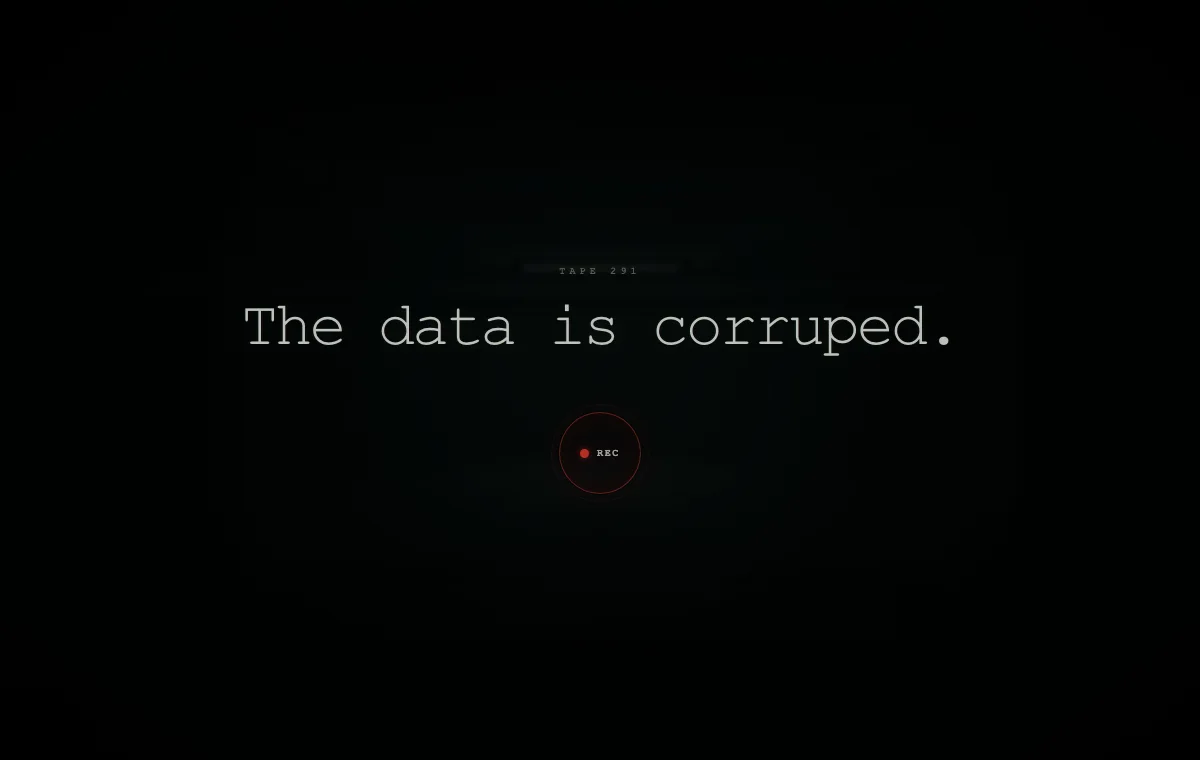
  5. Polished the environment and presentation with generated plaster, raised-floor, and acoustic-ceiling materials; repaired floor seams and wall intersections; refined fixture brightness; added a randomized tape number; and reduced the opening screen to 'The data is corrupted.' and a single 'REC' button.

  6. Final step

    Completed the final atmosphere and stability pass so the procedural maze, server variety, dynamic lighting, spatial audio, liminal materials, and VHS camera treatment felt like one cohesive experience. The production build was validated with automated connectivity, collision, spatial-audio, and rendering checks, then published through ChatGPT Sites.

Related projects